


Mózes Ince
Painter
was born in Barót in 1975 and graduated from the Târgu Mureș Art School in 1994 with a specialisation in mural painting.
In 2000, he earned his degree from the Hungarian University of Fine Arts, and since then, painting has been central to his existence.
His work explores the relationship between the constantly shifting present and the more enduring structures of tradition and form in painting. These explorations are reflected in his practice.
Mózes Incze aims to interpret the increasingly virtual world—shaped by the spread of technology—through the lens of human experience, creating space in his paintings for the soul to endure amidst the encroaching algorithms.
As a renowned winner of the Munkáscy Prize, he has exhibited his works outside Hungary in Germany, Italy, France, Spain, Belgium, Romania, the USA, South Korea and China.

Paintings

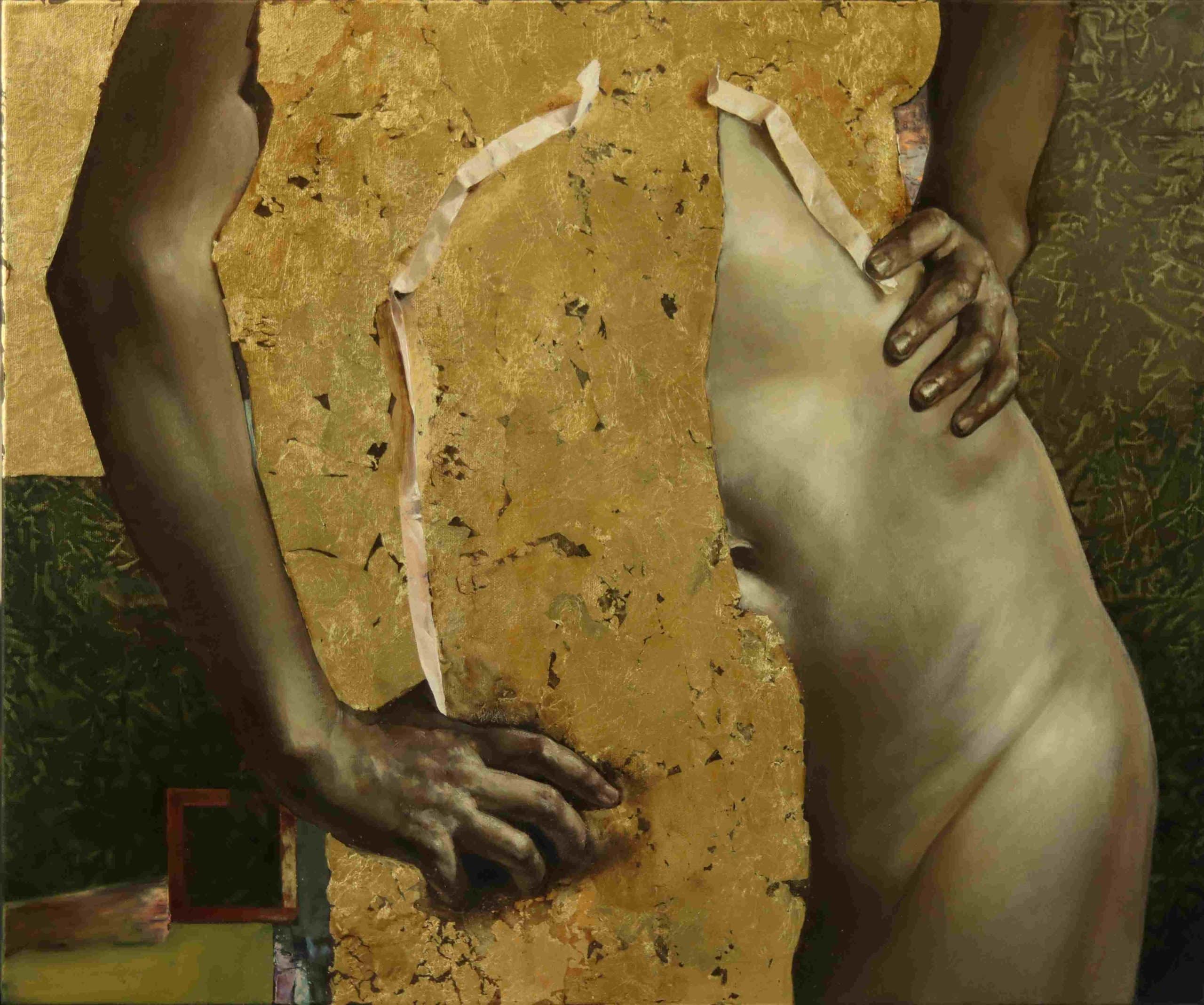
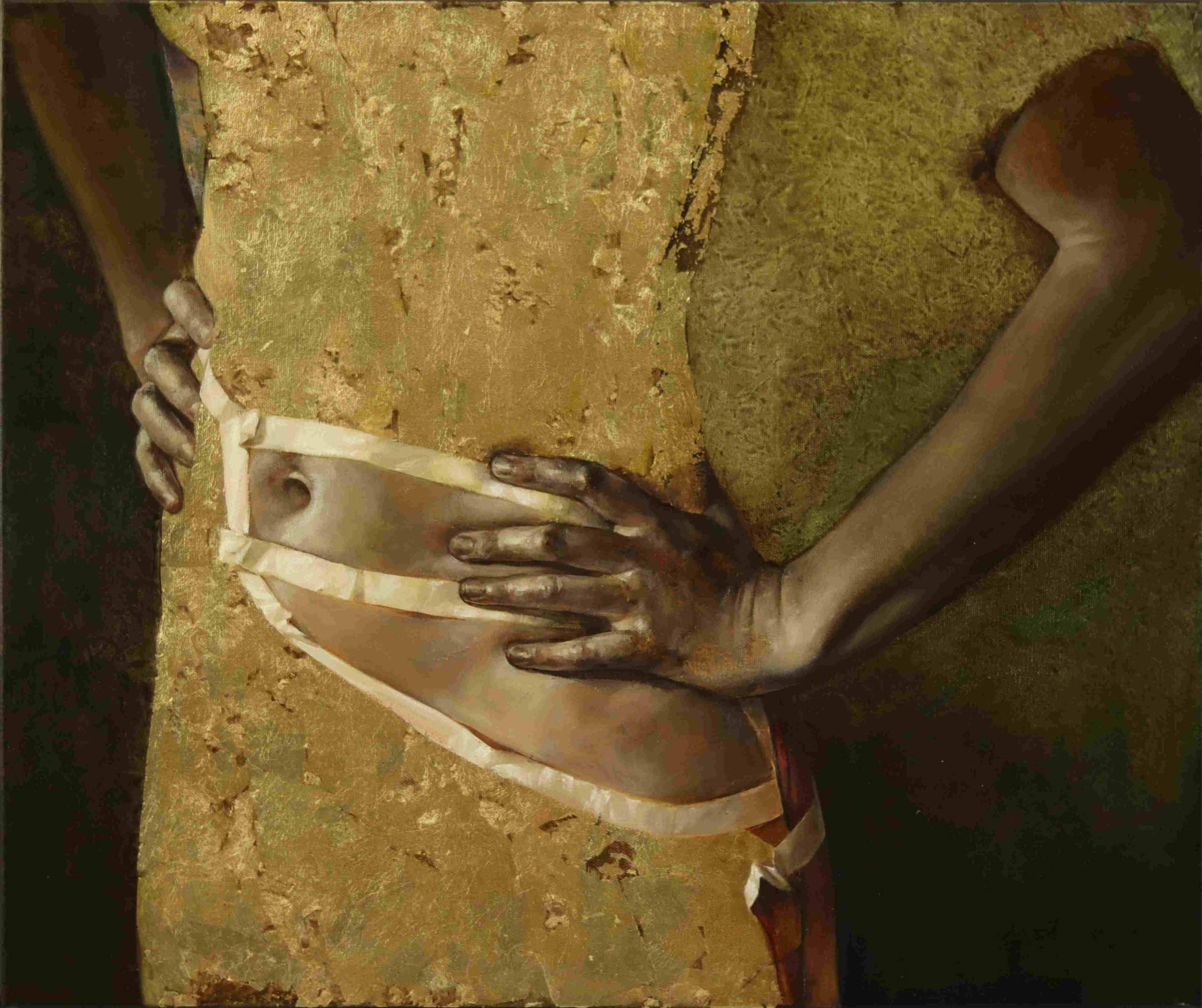
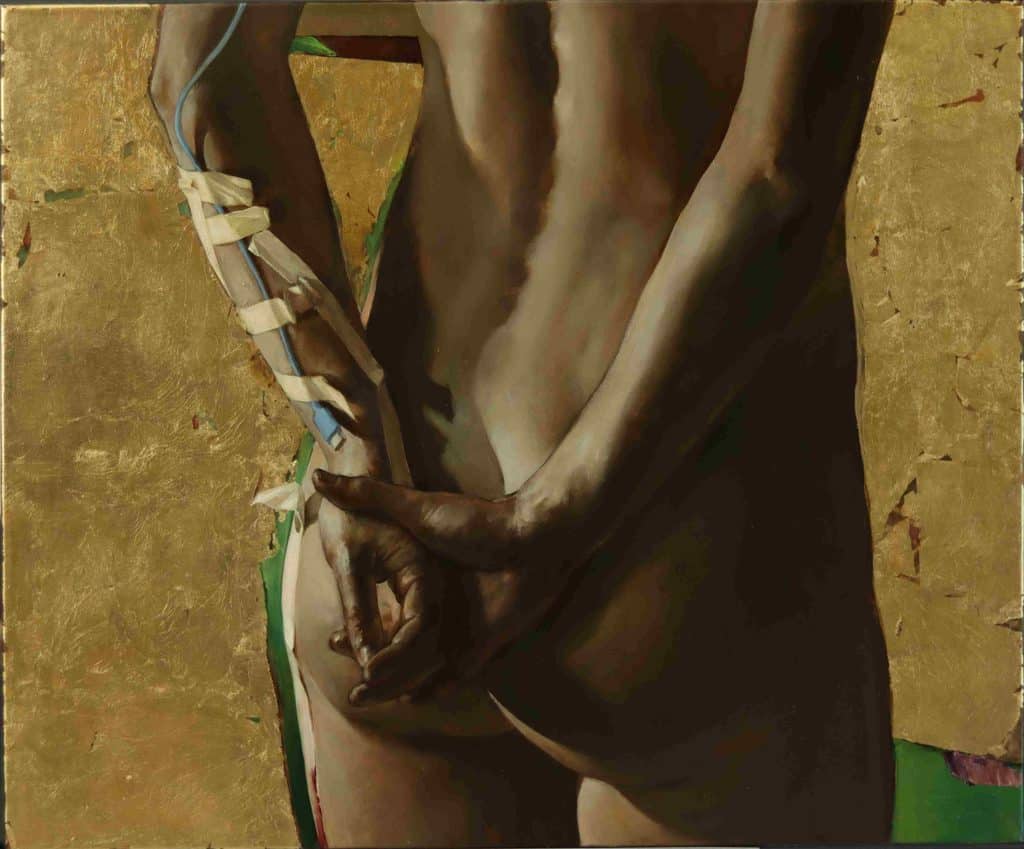
These three paintings by Mózes Incze are perfect examples of this contemporary artist’s distinctive style, which is rich in both visual and conceptual detail.
The textured golden surfaces that dominate the paintings evoke Byzantine icons and the early Renaissance. The anatomically precise, flesh-and-blood body parts, rendered with classical painterly care, form a sharp contrast to the flat, two-dimensional gold. This tension transposes the legacy of 19th- and 20th-century realism into a postmodern context. The absence of faces and the truncated, focused cropping of the bodies depersonalise the figures. We do not see specific portraits, but rather general human conditions, a kind of vulnerable experience of existence.
Mózes Incze’s work titled "Pandora” (2026) is one of the most exciting pieces in contemporary Hungarian figurative painting. The artist’s characteristic precise technical skill, reminiscent of the classical masters, meets a modern, almost conceptual mindset.
The title is a direct reference to Greek mythology. Pandora was the first woman who, out of curiosity, opened the mysterious box, unleashing evils upon the world but preserving hope. In the painter’s interpretation, this is not about an external box. Here, the human body itself, human existence, is the “box.” The torn-open golden band symbolizes the revelation of inner secrets, knowledge, or sin.
Gold is traditionally the color of sacredness and eternity. Here, however, it appears as a fragmented, damaged surface, conveying the tension between perfection and fragmentation.
Mózes Incze's painting entitled “Partial Bride”, the cropping focusing on the female figure's torso is intimate and tight. There is no environment in the picture, no face—thus the body becomes a fragment, almost a sculptural object. One of the characteristics of Mózes Incze's painting is the emphasis on texture, which in this case is particularly strong, with both the cracks and the silkiness palpable.
The artist usually does not paint complete figures, but rather body parts, which become independent carriers of meaning. The dominant browns, ochres, and deep green background create a warm yet heavy atmosphere in one of his most recent works.
Mózes Incze's art represents a particularly sensitive and profound strand of contemporary Hungarian painting. His works are characterized by quiet intensity, restrained drama, and the visual expression of inner experiences. Human figures often appear in Mózes Incze's paintings, but not in the classical sense of portraiture.
Surface treatment is an important element of Mózes Incze's work. The layered paintings, the partially worked and partially raw brushstrokes create the impression that the paintings themselves are imprints of an inner struggle.
In terms of colour, his works are characterized by restrained, often muted tones. Earth tones, greys, deep blues, and browns dominate the surfaces, occasionally broken up by a more powerful splash of colour. This painterly toolkit is not decorative but rather creates emotional emphasis: the colours convey mood, not merely describe form.